A landlord who ignores a broken heater or a leaking pipe isn't just risking an angry phone call. Under California Civil Code Section 1942.4, tenants can recover up to $5,000 in statutory damages when a landlord fails to fix a serious habitability issue after being notified. That's the real cost of a maintenance request left sitting in an inbox.
Maintenance disputes are one of the most common sources of tension in a landlord-tenant relationship, and most trace back to one question: who's responsible for the repair? California Landlord-Tenant law draws clear lines between landlord and tenant responsibilities, but those lines get blurry fast without a solid rental agreement and a basic understanding of the rules.
This guide covers what California landlords are legally required to maintain, what falls on tenants, and what happens when a repair request gets ignored.
Key Takeaways
- California landlords are generally responsible for structural repairs, essential systems, and habitability under the implied warranty of habitability
- Tenants are responsible for cleanliness, routine maintenance, and damage caused by their own negligence
- Lease agreements can assign certain minor tasks to tenants, but can't override state habitability law
- Ignoring necessary repairs can lead to repair and deduct claims, rent withholding, or legal disputes
What California Law Requires Landlords to Maintain
California landlords carry a legal duty called the implied warranty of habitability. It's built into every rental agreement, whether the lease mentions it or not.
California Civil Code Section 1942
Under California Civil Code Section 1942 and its companion sections, a dwelling unit must meet basic conditions to be considered livable. A rental unit generally must have:
- Working heat, plumbing, and hot and cold running water
- A functioning sewage disposal system
- Weatherproofing, unbroken doors and windows, and safe floors and railings
- Electrical systems and light fixtures that work as intended
- Clean and sanitary buildings, free of pests and debris
- Functioning carbon monoxide detectors and smoke alarms
These aren't optional extras. They're legally required repairs, and the property owner must keep them in working order for the life of the tenancy.
Structural Elements and Major Systems
Roofs, foundations, plumbing lines, and electrical wiring are squarely a landlord's job. Tenants can't be asked to pay for a failing HVAC system or a cracked foundation. These are core legal obligations tied to the property itself, not the people living in it.
Pest Infestations
If a pest problem exists before a tenant moves in or stems from the building's condition, the landlord generally must pay for extermination. That changes if the tenant's own habits caused the issue, which brings us to what tenants owe.
What Tenants Are Responsible for Maintaining
Tenant responsibilities focus on day-to-day upkeep and any damage they personally cause. Here are the areas that typically fall under the tenant's responsibilities in the lease agreement.
Cleanliness and everyday upkeep fall on the tenant
Most rental agreements require tenants to keep the rental unit clean, dispose of trash properly, and use appliances and fixtures as intended. Swapping a light bulb, keeping drains clear of grease, and reporting problems promptly are standard tenant duties.
Damage caused by tenant negligence is a tenant cost
Normal wear and tear is always the landlord's expense. A tenant-caused hole in the wall or a pet-damaged floor is different. California landlords can require tenants to cover repair costs tied to their own negligence, often through security deposits.
Minor fixture maintenance depends on lease terms
Some rental agreements shift small maintenance items, like changing furnace filters or lawn care in a single-family rental, onto the tenant. These terms need to be spelled out clearly, since anything conflicting with state habitability law won't hold up.
Gray Areas That Cause the Most Landlord-Tenant Disputes
Not every repair situation is black and white. Here are the areas that trip up landlords and tenants most often:
- Appliances not required by habitability law create ambiguity. A dishwasher or garbage disposal isn't always legally required. If the lease doesn't address who repairs it, disputes tend to follow. Spelling this out in the rental agreement upfront saves headaches later.
- Mold responsibility depends on the cause. Mold from a leaking roof is a landlord's problem. Mold from a tenant who never ran the bathroom fan is a tenant's problem. California local housing codes in cities from Orange County to San Francisco increasingly require documentation showing the source before assigning responsibility.
- Landscaping duties vary by lease and property type. Multifamily buildings usually leave landscaping to the property management team. Single-family rentals often push yard maintenance onto the tenant. Neither approach is automatically right or wrong, but it needs to be in writing.
At Coastal Oak Property Management, we spell out maintenance responsibilities in every lease agreement from day one, so residents and property owners across Orange County never have to guess.
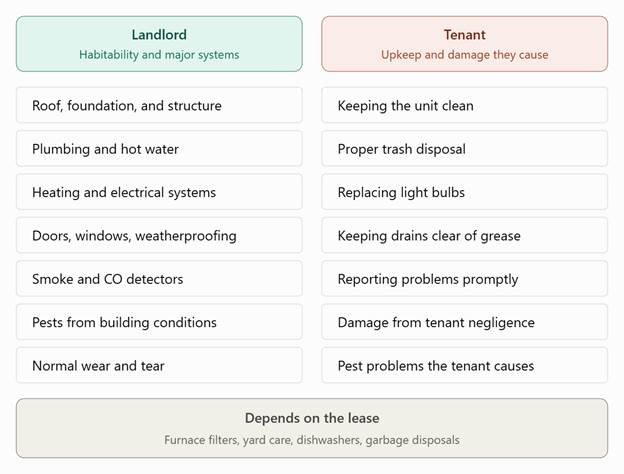
To make the split clearer, the chart below sorts common repairs by who's typically responsible.
What Happens When Repairs Are Ignored
Ignoring a repair request doesn't just delay the fix. It can lead to real consequences for both sides. Here's what's at stake:
- Tenants can use the repair-and-deduct remedy. If a landlord fails to make a necessary repair after receiving written notice, California tenants may pay for the fix themselves and deduct it from rent under Civil Code Section 1942. The cost typically can't exceed one month's rent, and the remedy is limited to twice in any 12-month period.
- Landlords can face habitability claims and withhold rent. Failing to act on legitimate repair requests can lead tenants to withhold rent or pursue legal action. Courts generally side with tenants when a landlord refuses to address conditions affecting a tenant's health and safety.
- Delays raise legal and financial exposure for everyone. Responding to maintenance requests promptly isn't just good practice. It's what keeps landlords out of court and keeps rent payments flowing without interruption.
FAQs: Maintenance Responsibilities in California
Q: Can a landlord require tenants to pay for pest control?
Only if the infestation resulted from the tenant's actions. Otherwise, pest control related to the building's condition is the landlord's expense.
Q: How much notice does a tenant need to give before withholding rent?
There's no fixed statewide grace period, but written notice and a reasonable amount of time for the landlord to respond are required before pursuing remedies like repair and deduct.
Q: Do California landlords have to install carbon monoxide detectors?
Yes. State law requires carbon monoxide detectors in most residential rental properties with fuel-burning appliances or an attached garage.
Getting Maintenance Responsibilities Right From the Start
Maintenance disputes almost always stem from unclear expectations. When a lease agreement doesn't spell out who handles what, small issues turn into drawn-out arguments over repair costs, timelines, and who's actually at fault.
The fix isn't complicated. A well-drafted rental agreement, documented repair requests, and a responsive landlord go a long way toward avoiding conflict. Add consistent communication on both sides, and most maintenance issues get resolved before they become a dispute.
Coastal Oak Property Management coordinates maintenance for residential rental properties throughout Orange County, so property owners stay compliant and tenants get repairs handled fast.
Reach out to see how our team keeps your rental protected.
More Resources:
- Hold, Sell, or Exchange? A Framework for Orange County Rental Owners at a Decision Point
- Why Your Orange County Rental Deserves a Portfolio Mindset, Not Just a Monthly Checklist
- Red Flags in Property Management Pricing: What Low Rates Might Be Hiding